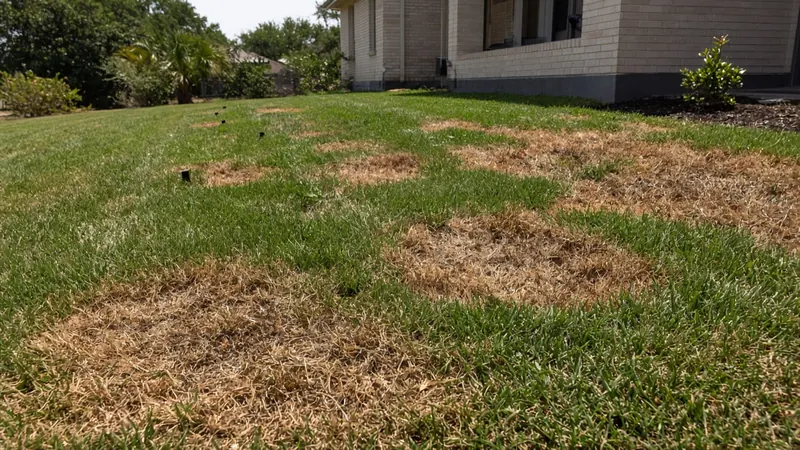
Sprinkler heads take more abuse than any other part of the system. They sit at ground level where mowers, edgers, cars and feet find them. Here is how to tell what is wrong and how to fix it right.
Signs of a broken head
- A geyser or bubbling where a head should be spraying
- A head that never rises, or rises only partway
- A head that sprays in the wrong direction or the wrong pattern
- A head that keeps leaking after the zone stops
- A brown ring or patch around one head
Why they break
Mowers and edgers clip the tops of heads set above grade.
Vehicles crush heads along driveways and curbs.
Sand and grit get into the gap around the stem, so it sticks up or down. This is common in sandy soils around New Caney.
Settling after heavy rain or construction leaves heads tilted or sunk.
Age. Seals and springs wear out.

Replacing a head properly
- Match the type. Spray to spray, rotor to rotor.
- Match the nozzle. Same pattern and similar flow, so the zone stays balanced.
- Use a swing joint. A flexible connection absorbs bumps and settling instead of snapping.
- Keep dirt out. Cover the open fitting while you work and flush the line before installing the head.
- Set it at grade. The top of the head level with the soil.
- Adjust the arc and throw so water lands on the lawn, not on concrete. Texas irrigation rules say new systems should not spray onto impervious surfaces.
When it is not the head
If every head on a zone is weak, the problem is upstream: a leak, a valve not fully open, or too many heads on one zone. That last one is common on builder systems. See new-construction sprinkler problems.
Cleaning a clogged head
Many weak heads are just clogged. Unscrew the nozzle, pull the screen under it, rinse both, and reinstall. Pine needles and sand are frequent culprits.
Spray or rotor?
Spray heads throw a fixed fan of water, usually up to about 15 feet, and suit small and narrow areas. Rotors throw a rotating stream much farther and suit open lawns. On builder systems, we often find sprays used on large open areas, which means more heads, more zones, and more chances for a mismatch. When a spray head breaks in a zone of sprays, replace it with a spray. When a rotor breaks, replace it with a rotor with a nozzle matched to the others on that zone.
Heads along driveways and curbs
The heads that break most often are along driveways, curbs and walks, where vehicles and edgers hit them. Setting those heads at least a few inches back from the concrete, using sturdy bodies, and keeping them flush with the soil reduces breakage. Texas rules for new systems require heads to be at least four inches from hardscape and aimed away from it.
Call us
If you have broken heads, or a zone that will not water evenly, call (346) 627-2444.
Have a question this did not answer? Call (346) 627-2444 and ask. More articles on the blog.